Leslie Bickers
Secret InvasionLeslie Bickers is a biologist at the VA Bio+Tech Park whose work turns an unexplained coastal crime scene into a confirmed biological emergency. Her examination of three strange eggs leads to the first witnessed hatching in her laboratory, her recognition of the creatures as Sliggers, and an urgent report to her superiors. Later, studying the remains of electrocuted hatchlings, she finds developing eggs inside them, revealing a reproductive threat that complicates efforts to contain the animals.
Identity and Scientific Approach
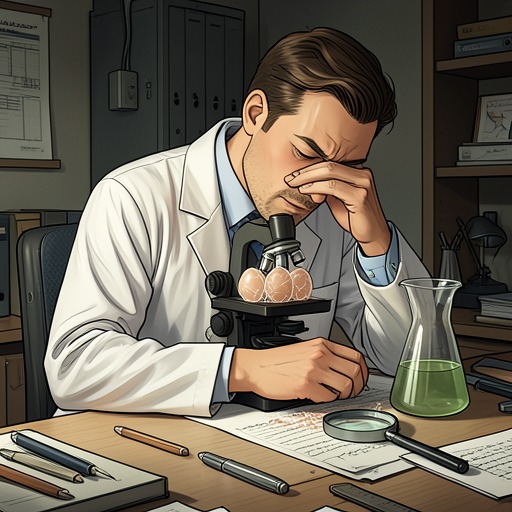
Leslie has spent fifteen years as a biologist, but the eggs brought to her laboratory are unlike anything she has encountered. They were recovered after a young boy was killed in the woods near Virginia Beach. His parents found a nest in the ground that may have held as many as ten eggs; by the time authorities arrived, only three remained intact, while the others appeared to have hatched. A search found no animals, leaving the eggs as the only specimens brought to the lab.
The eggs are roughly the size of footballs, oblong, greenish yellow, and bumpy. Their soft, thick, leathery coverings resemble giant alligator eggs rather than hard shells. Leslie is tempted to cut one open, but her sense of responsibility as a biologist restrains her: she intends to let the organism finish developing and limit her initial probing to the exterior and possibly samples drawn with a syringe. Her curiosity is intense, but it does not erase her professional caution.
That combination shapes her response throughout the crisis. Leslie approaches the specimens through observation and examination, and she communicates what the evidence can establish without pretending that the creatures fit familiar biological categories. Her scientific work supplies critical findings, even as the creatures repeatedly exceed the explanations available to her.
The Richmond Hatching
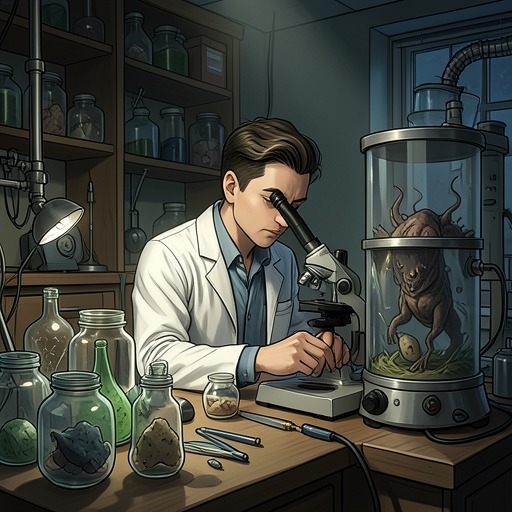
Leslie returns to work on a Saturday despite having barely slept. The eggs are important enough to outweigh both the weekend and the beautiful weather outside. After arriving at the VA Bio+Tech Park, she enters the quiet building, puts on her lab coat, and goes directly to the specimen tank. The eggs rest together on sterile gauze inside a clear Plexiglas enclosure. She lifts the steel mesh cover, takes one to the examining table, and studies it beneath a white lamp, marveling that her fifteen years in biology have not prepared her for anything comparable.
The hatching changes the laboratory from a place of controlled observation into the site of an immediate containment problem. The egg’s covering pushes outward; sharp structures pierce it and work together to tear it open. Leslie sees a dark-green head emerge, still draped in amniotic fluid, followed by jet-black eyes, a jaw with long, thin teeth, three pairs of tentacle-like appendages, amphibious legs, and a reptilian tail. The creature combines traits associated with several animal classes, defying the biological categories she knows. Movement from the other two eggs soon shows that the first hatchling is not alone: they, too, begin to open.
When the hatchlings lash at the tank’s cover, Leslie decides to reinforce it. She places thick textbooks on top of the cover to hold it down, then backs away, shaken and fascinated. The creatures’ appearance also triggers recognition. She remembers reports of sea monsters in South Carolina from the previous year and more recent news coverage; recovered body parts and witness descriptions match the animals in front of her. The creatures are Sliggers, a name witnesses had given them after a local’s bedtime bogeymen. Their presence in Virginia makes clear to Leslie that the threat has moved beyond the earlier reports—and may extend farther still.
Warning and Exchange of Findings
Leslie responds to that recognition by going to the phone and informing her superiors. This is a consequential shift in her role: she is no longer simply examining unusual specimens but reporting an active threat whose earlier appearances have already produced deaths. Her laboratory observation supplies direct confirmation that Sliggers are present in Virginia, where the recovered eggs have hatched into living animals.
The report brings her into contact with Ron Tully. After the Wildlife Service gives him her number, he calls and says that he and his associate are being sent to examine the situation. Leslie tells him that the three specimens have just hatched and are the most astonishing things she has seen. The exchange connects her laboratory evidence to the wider effort to understand and confront the creatures; her findings are of immediate interest beyond her own institution.
Leslie’s subsequent call to Ron comes after he and others have discussed how quickly the crisis may spread. In that conversation, she says she is concerned and explains that she has been studying the remains of animals the group electrocuted. Her examination has produced a concrete new finding: small eggs inside the dead hatchlings were already beginning to develop. Ron asks whether this indicates asexual reproduction. Leslie answers that some animals can reproduce that way, although none like this species. She establishes the observation; the exchange makes its implications explicit without suggesting that the reproductive mechanism is ordinary or fully understood.
Evidence, Containment, and Narrative Role
The developing eggs transform the meaning of the hatchlings’ remains. An animal killed in an encounter may still contain the next generation, so eliminating visible adults cannot by itself demonstrate that a site is free of reproductive risk. Leslie’s discovery therefore reinforces the response’s emphasis on locating nests and treating the aftermath of each encounter carefully. It also helps explain why Ron and the others focus not just on killing Sliggers but on finding their nesting places and preventing their remains from re-entering the food chain.
In the wider investigation, Leslie is distinct from the people directing field searches and public alerts. Her contribution is laboratory-based: she examines unfamiliar eggs, witnesses their emergence, recognizes the match with previous reports, contacts her superiors, and later detects developing eggs inside dead hatchlings. Other characters discuss the suspected connection between the creatures and material recovered from the Nazi submarine, but the evidence does not make Leslie the source of that theory or of the pending laboratory results. Her own findings instead establish the animals’ extraordinary physical form and an alarming reproductive fact.
Leslie’s scenes give the crisis a scientific point of entry without offering the comfort of a quick explanation. The eggs arrive as specimens that a careful biologist believes should be allowed to develop; within hours, their development produces creatures that threaten their containment. Later, even dead hatchlings contain evidence of further growth. Observation remains indispensable, but every new observation enlarges the problem that must be contained. Leslie’s importance lies in that tension: disciplined examination makes the danger more legible, while showing that the danger is already reproducing faster than established categories can account for.